
AI Plant Identifier: A Complete Guide to Identifying Plants with AI
Have you ever seen a plant and wondered, "What plant is this?" Identifying an unfamiliar plant can be difficult when you do not know its name, family, or growing requirements. An AI plant identifier can make this process much easier by analyzing a photograph and using visual characteristics to suggest what plant you may be looking at.
Instead of searching through hundreds of plant images, gardeners can use artificial intelligence to analyze visible features such as leaves, flowers, stems, growth patterns, and overall plant structure. This can be particularly useful for home gardeners, beginners, plant collectors, and anyone who regularly encounters unfamiliar plants.
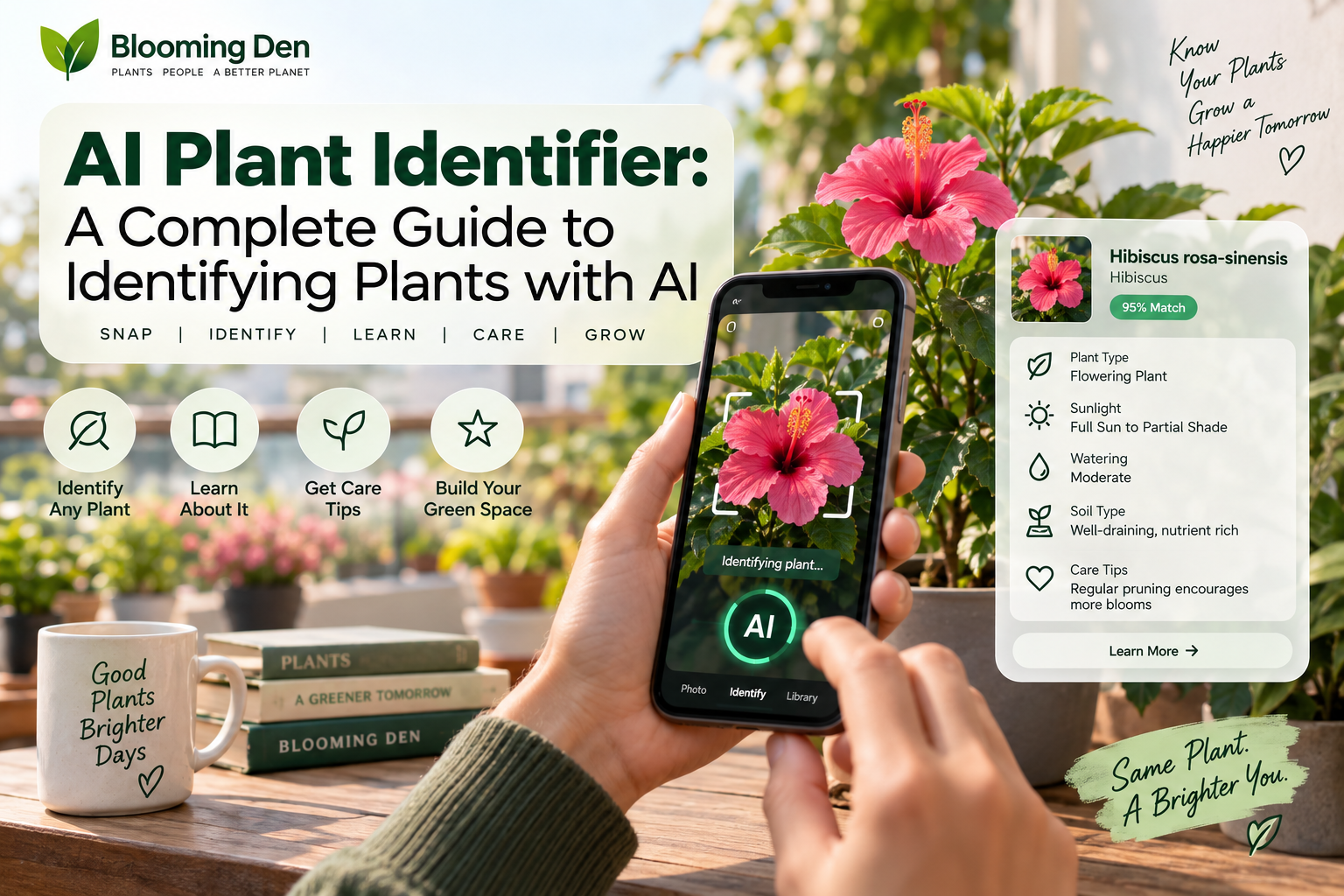
What Is an AI Plant Identifier?
An AI plant identifier is a technology that uses artificial intelligence and image analysis to identify plants from photographs. The system examines visible characteristics in an image and compares them with patterns and information learned from plant data.
Depending on the system, an AI plant identifier may provide a likely plant name along with additional information such as plant characteristics, growing conditions, sunlight requirements, watering guidance, and general care recommendations.
In Simple Terms
You provide a photograph of a plant, AI analyzes the visible features, and the system returns a likely identification along with useful plant information.
Why Use an AI Plant Identifier?
Traditional plant identification often requires searching gardening books, websites, or plant databases. This can take considerable time, especially when you only know what the plant looks like.
| Common Challenge | How AI Can Help |
|---|---|
| You do not know the plant name | Analyzes the photograph and suggests a likely identification. |
| Difficult to search manually | Uses visual characteristics instead of requiring a text search. |
| You want to learn about an unfamiliar plant | Can provide additional information about the identified plant. |
| You are a beginner gardener | Makes plant identification faster and easier to understand. |
How Does AI Plant Identification Work?
Although implementation varies between AI systems, the basic process is relatively simple. A plant photograph is processed by an image analysis system, which looks for visual patterns that can help distinguish one plant from another.
1. Upload a Plant Photo
The process starts with a photograph of the plant. A clear image generally provides more useful visual information.
2. Analyze Visual Features
AI examines visible characteristics such as leaf shape, color, flower structure, stems, and overall growth pattern.
3. Compare Patterns
The system compares the observed characteristics against patterns associated with known plants.
4. Generate Identification
The system provides a likely plant identification and, depending on the application, additional plant information.
What Features Can AI Analyze?
Plants have many visual characteristics that can help distinguish one species from another. AI can analyze several of these visible features when they are clearly captured in a photograph.
- Leaf shape and arrangement
- Leaf size and visible texture
- Leaf color and patterns
- Flower shape and color
- Stem appearance
- Overall plant structure
- Growth habit and branching pattern
- Visible fruits, seeds, or other identifying features
Important Note
AI identification is based primarily on the information visible in the photograph. Similar-looking plants, poor image quality, missing plant features, or unusual varieties can make identification more difficult. Treat an AI result as a useful identification aid rather than an absolute guarantee.
What Can an AI Plant Identifier Tell You?
Plant identification is only the first step. Once an AI system recognizes a plant, it can potentially help you understand more about its characteristics and general care requirements. This makes AI plant identification especially useful for beginners who may not know what a newly purchased or naturally growing plant needs.
Plant Name
AI can suggest the common name and, when supported by the system, potentially the scientific name of the plant.
Plant Characteristics
You may receive information about the plant's appearance, growth habit, flowers, foliage, and general characteristics.
Sunlight Requirements
Identification can be followed by general guidance about whether a plant typically prefers bright light, partial sunlight, or lower-light conditions.
Watering Requirements
AI-powered plant tools may provide general watering guidance based on the identified plant and its typical growing requirements.
Plants That Can Benefit from AI Identification
An AI plant identifier can be useful for many different types of plants. It can be particularly helpful when gardeners encounter plants whose names they do not know.
| Plant Category | Why Identification Helps |
|---|---|
| Indoor Plants | Helps beginners understand the care requirements of unfamiliar houseplants. |
| Flowering Plants | Identifies plants based on visible flowers, foliage, and growth characteristics. |
| Herbs | Can help distinguish unfamiliar herbs and provide general plant information. |
| Garden Plants | Useful when identifying plants already growing in outdoor spaces. |
| Trees and Shrubs | Leaves, branches, flowers, and overall structure can provide useful identification clues. |
AI Plant Identifier for Indoor Gardening
Indoor gardeners often collect plants from nurseries, friends, online stores, or plant exchanges without remembering their exact names. An AI plant identifier can make it easier to identify these plants using a simple photograph.
Once a plant is identified, gardeners can research whether it is suitable for their indoor environment, how much light it generally needs, how often it may require watering, and whether the current location is appropriate.
Example
Imagine you receive an unfamiliar houseplant as a gift. Instead of searching through hundreds of plant photographs, you can capture a clear image and use an AI plant identifier to get a likely identification. You can then use the plant information to learn about its general sunlight, watering, and care requirements.
AI Plant Identifier for Home Gardens
Outdoor gardeners can also use AI identification to understand plants already growing in balconies, terraces, backyards, community gardens, and other outdoor spaces.
Knowing the plant's identity can make subsequent gardening decisions easier. For example, you may want to understand its mature size, sunlight preference, watering needs, seasonal behavior, or compatibility with the available garden space.
AI Identification vs Traditional Plant Identification
| Factor | Traditional Method | AI-Assisted Method |
|---|---|---|
| Input | Plant descriptions, books, or manual searches | Primarily a plant photograph |
| Speed | Can require extensive searching | Can provide results quickly |
| Accessibility | Requires plant knowledge or research | More accessible to beginners |
| Additional Information | Usually requires separate research | Can be integrated into the identification experience |
Why Image Quality Matters
AI needs visible information to make an identification. A photograph that clearly shows important plant characteristics generally provides more useful information than a distant, blurry, or poorly lit image.
- Capture the plant in good natural light when possible.
- Keep the main plant clearly visible.
- Avoid excessive blur or motion.
- Show leaves and other identifying features.
- Include flowers or fruits if they are present.
- Avoid covering important parts of the plant.
Better Photos, Better Identification
If the first result is uncertain, try another photograph from a different angle. A close-up of leaves, flowers, or other distinctive features can provide additional visual information and may improve the identification.
How to Use an AI Plant Identifier Effectively
Getting a plant identification from AI is simple, but the way you capture and provide information can significantly affect the usefulness of the result. A good photograph combined with a little context can help the AI make a more informed identification.
Step 1: Choose the Plant You Want to Identify
Start with a single plant that you do not recognize. If several plants are present in the same image, it may be difficult to determine which plant you want to identify. A photograph focused primarily on the target plant is usually more useful.
Step 2: Capture a Clear Photograph
Take a photograph where the plant is clearly visible. Natural daylight is often useful because it makes colors, leaf shapes, and other visual characteristics easier to see.
Step 3: Show Important Features
If possible, capture leaves, flowers, stems, fruits, or other distinctive features. For plants with small or unusual leaves, a closer photograph can provide more useful information than a distant image.
Step 4: Review the Identification
Review the suggested plant name and compare it with the visible characteristics of your plant. If the result is uncertain, provide another photograph or investigate the suggested alternatives.
Step 5: Learn About the Plant
Once you have a likely identification, learn about the plant's typical sunlight, watering, soil, temperature, growth, and maintenance requirements before changing its care routine.
What Information Can Improve Plant Identification?
A photograph is the primary input for many AI plant identification tools, but additional context can be helpful when available. Information about where and how the plant is growing can provide useful clues.
| Information | Why It Can Help |
|---|---|
| Location | The geographic region can provide useful context for possible plant species. |
| Indoor or Outdoor | Helps provide context about the plant's growing environment. |
| Flowers | Flower shape, color, and arrangement can be useful identification features. |
| Fruits or Seeds | Visible fruits and seeds can provide additional clues. |
| Growth Pattern | Information about whether the plant grows upright, spreading, climbing, or trailing can be useful. |
AI Plant Identification for Gardening Beginners
Beginners often buy plants based on appearance without knowing their names or care requirements. An AI plant identifier can reduce this uncertainty and make it easier to start learning about plants.
For example, if you receive an unidentified plant from a friend or find a plant growing in your garden, you can use its photograph as the starting point for learning. After identifying it, you can research its preferred light, watering habits, soil requirements, mature size, and other care needs.
A Simple Beginner Workflow
- Take a clear photograph.
- Identify the plant using AI.
- Check the suggested identification.
- Learn the plant's basic requirements.
- Compare those requirements with your garden.
- Adjust care only when you understand the plant's needs.
Using AI Plant Identification to Improve Plant Care
Correct identification can be an important first step toward better plant care. Different plants have different preferences, so knowing the plant helps you avoid applying the same care routine to every plant.
Sunlight
Learn whether the identified plant generally prefers full sunlight, partial sunlight, bright indirect light, or other conditions.
Watering
Understanding typical moisture preferences can help you avoid unnecessary overwatering or underwatering.
Soil
Plant identification can help you research the type of soil and drainage conditions the plant generally prefers.
Space
Knowing the plant helps you understand its potential size and whether the current pot or garden location may be suitable.
AI Plant Identifier for Plant Shopping
Plant identification can also be useful when planning what to buy for a garden. If you already have several plants, identifying them first can help you understand the existing collection before purchasing additional plants.
Instead of buying plants based only on appearance, you can consider their sunlight requirements, growth habits, maintenance needs, and compatibility with the available space. This can help create a more balanced and manageable garden.
Identify Before You Add
Before adding more plants to your collection, identify what you already have. Understanding your existing plants can help you make more thoughtful decisions about new additions, containers, placement, and garden design.
What AI Plant Identifiers Cannot Reliably Tell You from One Photo
AI can analyze what is visible in an image, but a photograph does not contain every piece of information needed to understand a plant. Some important conditions require physical inspection or additional context.
- Exact soil condition
- Root health
- Actual soil moisture
- Drainage problems hidden inside a container
- Exact sunlight exposure throughout the day
- Underground pests or root diseases
- Precise nutrient deficiencies without additional evidence
Use AI as an Identification Assistant
An AI plant identifier is most useful as a convenient starting point. When identification is uncertain or the plant shows serious health problems, verify the result with reliable plant references or a qualified gardening professional before making major changes.
Common Mistakes When Using an AI Plant Identifier
AI plant identification can make identifying unfamiliar plants much easier, but the quality of the result depends on the photograph, visible plant features, and the capabilities of the AI system. Avoiding a few common mistakes can make the experience more useful.
Using a Blurry Photograph
A blurry photograph can hide important details such as leaf shape, texture, flower structure, or stem characteristics. Try to keep the camera steady and make sure the main parts of the plant are in focus.
Photographing the Plant from Too Far Away
A distant photograph may show the overall plant but not enough detail for accurate identification. When possible, capture a closer image of the leaves, flowers, or other distinctive features.
Using Very Dark or Overexposed Images
Poor lighting can make plant colors and structures difficult to recognize. Natural, even lighting can make important visual characteristics easier for an AI system to analyze.
Including Too Many Plants
If several plants appear together, it may be unclear which plant you want to identify. Focus the photograph on one plant whenever possible.
Assuming Every AI Result Is Perfect
AI identification is a prediction based on available visual information. Similar species, cultivars, hybrids, unusual varieties, or incomplete photographs can result in an incorrect or uncertain identification. Always consider the result as a helpful starting point rather than an unquestionable answer.
How to Improve an Uncertain Plant Identification
Sometimes the first photograph does not provide enough information. Rather than immediately accepting an uncertain result, you can provide additional visual information.
| Problem | What to Try |
|---|---|
| Leaves are difficult to see | Take a closer photograph of several healthy leaves. |
| Flowers are hidden | Capture the flowers clearly when they are visible. |
| Plant is too small in the image | Move closer while keeping the entire relevant plant area visible. |
| Lighting is poor | Capture another image in clearer, more even lighting. |
| Several plants look similar | Provide additional close-up views and compare the suggested possibilities. |
AI Plant Identifier and Plant Health
Plant identification and plant health analysis are related but different tasks. Knowing the plant's identity can provide useful context for understanding its normal appearance and care requirements, while health analysis focuses on visible signs of stress, damage, or disease.
For example, yellow leaves can have many possible causes. An AI system may recognize the visible symptom, but determining the exact cause may require information about watering, sunlight, soil, pests, temperature, recent changes, and other environmental conditions.
Identification First, Diagnosis Second
Identifying a plant can be a useful first step, but plant identification should not automatically be treated as a disease diagnosis. Health problems may require additional photographs, environmental information, physical inspection, or professional horticultural advice.
Frequently Asked Questions About AI Plant Identification
What is an AI plant identifier?
An AI plant identifier is a tool that uses artificial intelligence and image analysis to recognize plants from photographs and suggest a likely plant identity.
Can I identify a plant from a photo?
Yes. AI-powered identification tools can analyze a plant photograph and suggest possible matches based on visible characteristics such as leaves, flowers, stems, and overall structure.
Can AI identify indoor plants?
Yes. Indoor plants can often be identified from photographs when sufficient visual features are visible.
Can AI identify plants without flowers?
In many cases, yes. Leaves, stems, growth patterns, and other visible characteristics can provide identification clues even when flowers are not present. However, some plants may be harder to distinguish without flowers or fruits.
Is an AI plant identifier always accurate?
No. Accuracy depends on the quality of the image, the visible plant characteristics, and the AI model. Similar species and unusual varieties can make identification difficult.
Can AI identify a plant from one leaf?
A single leaf may contain useful identification information, but some plants have similar-looking leaves. A photograph showing more of the plant can provide additional context and improve the identification process.
Can an AI plant identifier tell me how to care for the plant?
Many AI-powered plant tools can provide general care information after identifying a plant, including typical sunlight, watering, soil, and maintenance requirements.
Can AI identify a plant disease?
Some AI systems can analyze visible symptoms and suggest possible plant health problems, but plant identification and disease diagnosis are different tasks. Serious or unclear health issues should be evaluated using additional evidence or professional advice.
A Practical Reminder
Use AI plant identification to learn and investigate, but verify important information before making major decisions about a plant. Especially for rare plants, potentially toxic plants, serious health problems, or plants intended for consumption, additional reliable verification is recommended.
AI Plant Identifier: A Simple Checklist
Whether you are identifying a new houseplant, a garden plant, or an unfamiliar plant you discovered outdoors, following a simple process can help you get more useful results from an AI plant identifier.
Plant Identification Checklist
- Choose the specific plant you want to identify.
- Take a clear and focused photograph.
- Use good, natural lighting when possible.
- Make sure the plant is clearly visible.
- Capture leaves, flowers, or fruits when available.
- Take additional photographs if the first result is uncertain.
- Review the suggested plant identification.
- Verify important information using reliable references.
- Research the plant's sunlight, watering, soil, and space requirements.
- Use the information to create an appropriate care routine.
How AI Plant Identification Can Change Gardening
Plant identification is one of the first steps toward understanding a garden. When gardeners know what plants they have, they can make more informed decisions about placement, watering, sunlight, containers, maintenance, and future additions.
AI makes this process more accessible by allowing people to begin with something they already have: a photograph. This can be particularly valuable for beginners who may not know botanical terminology or where to start their research.
| Without Identification | With Plant Identification |
|---|---|
| Uncertainty about the plant | A starting point for learning about the plant |
| Generic care routines | Care can be adjusted to the plant's typical requirements |
| Difficult manual research | Faster visual identification |
| Guessing when buying or placing plants | More informed gardening decisions |
AI Plant Identifier as Part of a Smart Gardening Experience
Plant identification can become even more useful when combined with other gardening technologies. Instead of using AI only to discover a plant's name, the identification result can become the starting point for a broader gardening experience.
Plant Identification
Identify an unfamiliar plant from a photograph and learn about its general characteristics.
Plant Health Analysis
Analyze visible symptoms and identify areas that may require further attention.
Garden Analysis
Understand how identified plants fit within the wider garden and available space.
Personalized Recommendations
Use plant and garden information to make more informed decisions about care, placement, and future improvements.
The Future of AI Plant Identification
As artificial intelligence and computer vision continue to improve, plant identification can become more detailed and useful. Future systems may combine visual identification with information about the plant's environment, garden history, local conditions, and user preferences.
This could make it possible to move beyond simply answering "What plant is this?" and toward questions such as "Where should I place it?", "How should I care for it?", and "What other plants work well with it?"
From Identification to Personalization
The real value of AI plant identification is not just recognizing a plant. It is using that information as a foundation for better, personalized gardening decisions.
Final Thoughts
An AI plant identifier provides a convenient way to investigate unfamiliar plants using photographs. By analyzing visible characteristics such as leaves, flowers, stems, and overall plant structure, AI can provide a useful starting point for identifying plants and learning more about them.
For beginners, this can make gardening easier to understand. For experienced gardeners, it can provide a quick way to investigate plants encountered in gardens, nurseries, homes, and outdoor spaces.
However, AI identification should be treated as an assistance tool rather than a replacement for reliable botanical references or professional horticultural expertise. Clear photographs, additional context, and verification are especially important when identification affects plant safety, consumption, or significant gardening decisions.
Discover Smarter Gardening with BloomingDen
BloomingDen brings technology and gardening together to help you better understand your plants and garden. From plant identification and plant care to garden analysis and improvement, smart gardening tools can make it easier to create and maintain a healthier, more beautiful space.
Explore BloomingDen for practical gardening resources, plant-care guidance, smart gardening solutions, and ideas for growing a better garden.